
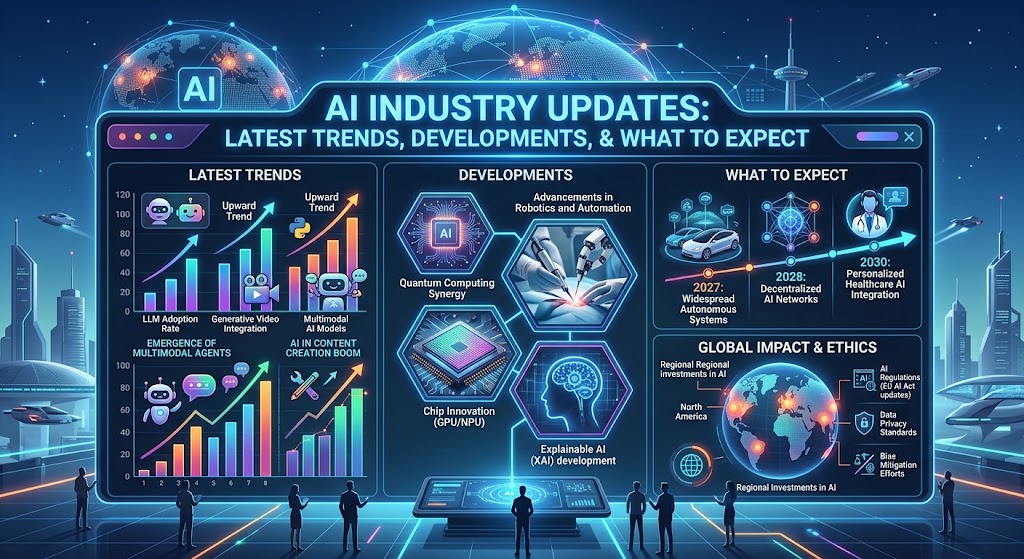
Artificial intelligence is changing quickly, and new developments appear almost every week. AI models are becoming more capable, businesses are adopting automation, and developers are finding new ways to use intelligent software in everyday products.
For anyone following technology, keeping up with AI industry updates can be difficult. New models, startups, tools, research projects, and business announcements constantly appear across the technology sector.
This guide explains the major areas shaping the AI industry, what businesses are focusing on, how AI tools are changing, and what users can expect from the next generation of artificial intelligence.
What Are AI Industry Updates?
AI industry updates are recent developments related to artificial intelligence technology and the companies, products, research, and markets surrounding it.
These updates can include:
- New AI models
- AI software releases
- Research breakthroughs
- Business partnerships
- AI startups
- Data center investments
- AI chips and hardware
- New workplace tools
- AI regulations
- Generative AI developments
Following these areas can help businesses and technology users understand where the industry is moving.
Generative AI Continues to Grow
Generative AI remains one of the most visible areas of artificial intelligence.
Instead of simply analyzing existing information, generative AI systems can create new content based on user instructions. Depending on the system, this may include text, images, audio, video, software code, and other digital content.
Businesses are experimenting with generative AI for customer support, marketing, software development, research, document processing, and internal knowledge systems.
The focus is also shifting from simple demonstrations to practical applications that solve specific business problems.
AI Agents Are Getting More Attention
One of the major themes in AI development is the rise of AI agents.
A traditional chatbot generally responds to a user’s message. An AI agent can be designed to complete a series of tasks using connected tools.
For example, an agent could potentially:
- Receive a request.
- Search relevant information.
- Analyze the results.
- Use another software tool.
- Complete an action.
- Report the result to the user.
The exact capabilities depend on the system, permissions, and tools available.
This approach could make AI more useful for repetitive business workflows and digital tasks.
AI Is Becoming More Multimodal
Another important development is multimodal AI.
Earlier AI systems were often designed around a single type of input, such as text. Modern systems increasingly work with combinations of text, images, audio, video, and other information.
A multimodal system may allow users to upload an image and ask questions about it, speak naturally with an AI assistant, or combine text instructions with visual information.
This makes AI interaction feel more flexible because users do not always have to communicate through written prompts.
AI Coding Tools Are Expanding
Software development is another area experiencing rapid AI adoption.
AI coding assistants can help developers generate code, explain unfamiliar functions, identify potential bugs, write tests, and work with documentation.
Some newer systems are designed to handle larger portions of development workflows rather than simply suggesting individual lines of code.
However, human review remains important. AI generated code can contain errors, security problems, outdated approaches, or logic that does not match the requirements of a particular project.
AI Hardware Is Becoming More Important
The growth of AI software is increasing demand for powerful computing infrastructure.
Training and operating advanced AI models can require significant computing resources. This has increased attention on specialized processors, data centers, networking technology, and energy requirements.
AI hardware companies are working on processors designed specifically for machine learning workloads.
Cloud providers are also investing heavily in infrastructure that allows businesses to access AI computing without owning large physical systems themselves.
Smaller AI Models Are Becoming Useful
AI development is not only about building larger models.
Smaller models can offer advantages when users need lower costs, faster responses, privacy, or local processing.
Some organizations may prefer a smaller model for a specific task rather than using a very large general purpose system.
Local AI can also reduce the need to send certain information to a remote server, although the actual privacy benefits depend on how the software is designed.
Businesses Are Moving From Experiments to Practical Applications
Many companies initially experimented with AI simply to understand what the technology could do.
The focus is increasingly moving toward measurable business applications.
Examples include:
Customer Service
AI assistants can help answer common questions and route more complicated requests to human employees.
Document Processing
AI can extract useful information from large collections of documents and organize it for further analysis.
Marketing
Companies can use AI to generate content ideas, summarize customer feedback, and support campaign planning.
Software Development
AI tools can assist developers with coding, testing, documentation, and debugging.
Research
AI can help organize information and identify patterns across large amounts of data.
The value of these applications depends on accuracy, implementation quality, security, and the specific business problem being addressed.
AI Safety and Security Remain Important
As AI becomes more powerful, security has become an important part of industry discussions.
Organizations need to consider risks such as:
- Incorrect AI generated information
- Data leakage
- Prompt injection
- Unauthorized access
- Model misuse
- Privacy problems
- Insecure AI integrations
Companies deploying AI systems need appropriate testing and monitoring.
Human oversight is particularly important when AI is used for decisions that can significantly affect people.
AI Regulation Is Developing
Governments around the world are working on rules and policies related to artificial intelligence.
Regulatory discussions often cover areas such as privacy, transparency, safety, copyright, consumer protection, and the use of AI in sensitive sectors.
The legal environment can vary significantly between countries.
Businesses using AI should therefore monitor regulations relevant to their industry and location rather than assuming that one set of rules applies everywhere.
AI and Search Are Changing
Search technology is also being influenced by artificial intelligence.
AI powered search experiences can provide direct summaries and conversational answers instead of relying entirely on traditional lists of web links.
For website owners, this makes useful and trustworthy content increasingly important.
Publishing content simply to target keywords may not be enough. Websites should provide original information, clear explanations, accurate facts, and a good experience for readers.
AI can help with content production, but human editing and fact checking remain valuable.
The Importance of Original Content
As AI generated content becomes easier to produce, the internet may contain more material that looks similar.
This creates an opportunity for websites that provide genuine value.
Original research, firsthand experience, useful examples, expert commentary, unique data, and clear explanations can make content more useful to readers.
AI can assist with writing, but adding real human value can help distinguish an article from thousands of generic pages.
What Should Businesses Watch Next?
Several areas are likely to remain important for people following AI industry updates.
AI Agents
More companies are exploring systems that can perform multi step tasks instead of simply generating responses.
Multimodal Systems
AI that understands multiple forms of information may become increasingly common.
AI Infrastructure
Demand for processors, cloud computing, networking, and data centers is expected to remain an important industry topic.
Smaller Models
Efficient models may become increasingly useful for specialized applications and local devices.
AI Governance
Companies will continue adapting to changing laws, standards, and internal policies.
Human and AI Collaboration
Many organizations are focusing on ways humans and AI can work together rather than treating AI as a complete replacement for every task.
How to Keep Up With AI Industry Updates
The AI industry moves quickly, so following random social media posts can make it difficult to separate meaningful developments from speculation.
A better approach is to follow several types of sources.
Look for:
- Official company announcements
- Research papers
- Government publications
- Technology documentation
- Independent reporting
- Industry analysis
- Product release notes
When reading a major AI announcement, check the original source whenever possible.
A headline can make a technology sound more capable than it actually is. Looking at the underlying documentation can provide a clearer picture.
Final Thoughts
AI industry updates cover much more than new chatbots. The sector includes generative AI, agents, software development, hardware, cloud infrastructure, multimodal systems, regulation, cybersecurity, and business adoption.
The technology is developing rapidly, but not every new announcement represents a major breakthrough. The most useful way to follow the industry is to look beyond headlines and examine what a new system actually does, who can use it, and what practical problem it solves.
For businesses and individuals, staying informed can make it easier to identify useful AI applications while also recognizing the limitations and risks involved.
AI will continue to evolve, and the companies and users that understand both its capabilities and its limitations will be better prepared to adapt as new developments emerge.
About The Author
