
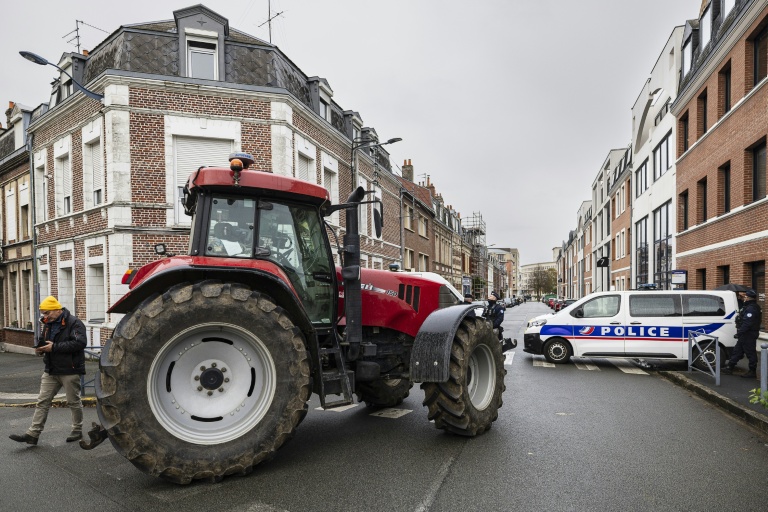
PARIS – Against a backdrop of rumbling tractors and simmering discontent, French President Emmanuel Macron walked into the lion’s den of the annual International Agriculture Show in Paris this weekend. His mission: to confront farmers directly and attempt to quell a protest movement that has swept across France and Europe, with a contentious EU trade deal with South American nations at the heart of the fury.
The scene was tense, emblematic of a deepening crisis. For months, French farmers have blockaded highways, dumped manure, and rallied in town squares. Their grievances are many: rising costs, suffocating bureaucracy, and what they see as unfair competition from abroad. But one issue has become a potent symbol of their frustration: the looming EU-Mercosur trade agreement, which would significantly liberalize trade between the European Union and Argentina, Brazil, Paraguay, and Uruguay.
The Mercosur Flashpoint
The proposed deal, two decades in the making, aims to create one of the world’s largest free-trade zones. For European exporters, it promises new markets for cars, chemicals, and luxury goods. However, for European farmers, particularly in the beef, poultry, and sugar sectors, it is viewed as an existential threat.
Farmers fear being undercut by imports produced under environmental and health standards they argue are far lower than the stringent—and costly—rules they must follow in France and the EU. The sight of Brazilian beef, raised on land linked to deforestation and often using growth hormones and antibiotics banned in Europe, flooding the market is a nightmare scenario for the French agricultural sector.
“We are being asked to produce greener, to sacrifice income for the environment, and at the same time, they want to sign a deal that will bring in products that ignore all these rules,” said Jean-Baptise B., a cattle farmer from Normandy, speaking to reporters outside the show. “It’s a betrayal.”
Macron’s High-Stakes Dialogue
Recognizing the political firestorm, Macron has positioned himself as a defender of European agricultural sovereignty. In a series of heated, face-to-face exchanges with farmers at the show—a traditional presidential testing ground—he sought to reassure them.
“The deal as it stands is not good for our farmers, for our environment, or for our consumers,” Macron stated firmly during one discussion. “I have said clearly: France opposes the Mercosur agreement in its current form. There will be no agreement if it does not respect our climate and biodiversity objectives and if it does not guarantee reciprocity in the rules.”
His message was a mix of empathy and hard-nosed politics. He acknowledged the “legitimate anger” and promised to fight for major revisions, including mirror clauses that would require imports to meet EU production standards. He also announced new, immediate support measures, including simplified paperwork and faster aid payments, to address the day-to-day pressures farmers face.
The European Tightrope
Macron’s challenge is a diplomatic tightrope. While he must placate a vital domestic constituency ahead of June’s European Parliament elections—where the farmer’s vote is keenly contested by the far right—he also must navigate complex EU-level negotiations. Countries like Germany and Spain are more favorable toward the deal, seeing benefits for their industrial exporters.
The French president is therefore pushing a two-pronged strategy: domestic appeasement coupled with a demand for a fundamental “re-orientation” of EU trade policy. He argues Europe must not sacrifice its strategic autonomy or its green transition for the sake of trade liberalization.
“We need a European preference,” argued Macron. “Our trade policy cannot be naïve.”
Skepticism on the Ground
Despite the president’s forceful rhetoric, skepticism among farmers remains deep. Many have heard similar promises before.
“Words are cheap. We’ve been hearing ‘never this deal’ for years, but the negotiations keep going,” said Sophie Devienne, an agronomist and farm union advisor. “Farmers need concrete, irreversible actions, not just political positioning during an election season.”
Union leaders have given Macron until the next EU summit to deliver tangible progress, threatening to resume widespread protests if their demands are not met. They want the Mercosur deal abandoned entirely, not merely amended.
A Broader Battle for the Soul of Europe
The confrontation over Mercosur transcends agriculture. It reflects a pivotal debate about the future of Europe: Should it remain committed to open markets and global trade deals, or should it pivot toward greater protectionism and “strategic autonomy” to shield its industries and standards?
Macron’s farm show gambit is an attempt to steer this debate. By aligning himself with farmers’ anger, he seeks to channel it into a broader project of a more assertive, sovereignty-focused Europe. Whether he can successfully defuse the immediate anger, however, depends on his ability to translate his Parisian declarations into concrete wins in Brussels boardrooms.
For now, the tractors are silent, parked as farmers gauge the president’s next move. But the engines are still warm, a reminder that the fields of France remain a potent force, capable of bringing the country to a halt and shaping the future of Europe itself. The success of Macron’s bid for dialogue will be measured not in the handshakes at an agricultural show, but in the quiet fields and bustling markets where the fate of French farming is ultimately decided.
About The Author
