
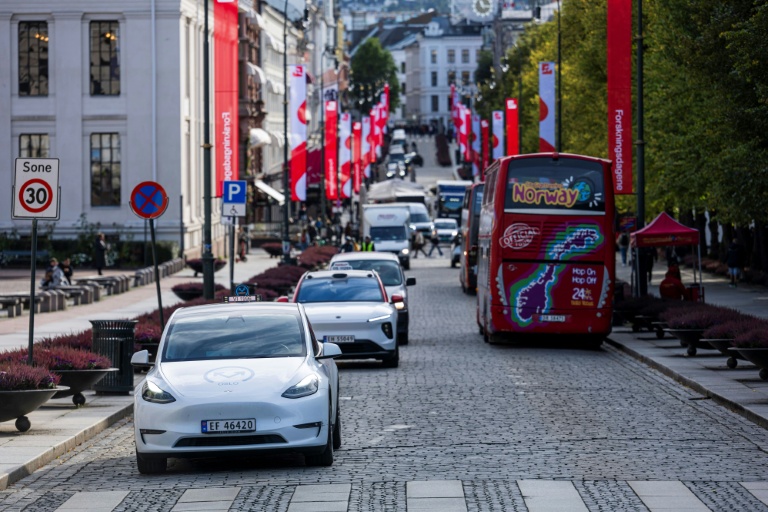
While Tesla faces headwinds in much of Europe—with slowing demand, stiff competition, and logistical challenges—there exists a striking outlier in the frigid north. Norway, a country of just 5.5 million people, has consistently served as Tesla’s record-breaking European powerhouse, defying broader continental trends. Here, the American electric vehicle (EV) pioneer isn’t just competing; it’s dominating, repeatedly setting sales records that offer a fascinating blueprint for mass EV adoption.
A Record-Breaking Phenomenon
Recent months have painted a clear picture of this dichotomy. As Tesla’s European deliveries showed signs of strain in major markets like Germany and France, Norway kept delivering staggering numbers. The Tesla Model Y wasn’t just the best-selling car in Norway in 2023; it became the single best-selling vehicle of any kind, ever, in the country’s history. It consistently captures over 20% of the entire new car market in some months—a market share figure that is virtually unheard of for a single model in any developed nation.
This isn’t a one-hit wonder. The Model Y’s predecessor, the Model 3, similarly shattered records upon its release. In Norway, Tesla’s sales charts look like vertical lines, contrasting sharply with the more gradual adoption curves seen elsewhere on the continent.
The “Why Norway?” Equation: More Than Just Incentives
Understanding this success requires looking beyond simple economics. While Norway’s aggressive policy framework is the foundational catalyst, several intertwined factors create a perfect ecosystem for Tesla’s dominance.
1. The Policy Superhighway: Norway’s journey began decades ago. A long-term, bipartisan commitment to zero-emission vehicles has created the world’s most supportive EV environment.
- Financial Nirvana: EVs are exempt from heavy import duties, registration taxes (which can double the price of an ICE car), and the 25% VAT. This makes a Tesla Model Y competitively priced with a Volkswagen Golf.
- Operational Benefits: Toll-free roads, ferries, bus-lane access in cities, and ubiquitous free charging at public car parks drastically reduce the cost and hassle of ownership.
2. A Culture of Early Adoption: Norwegians have a deep-seated environmental consciousness, amplified by the nation’s own wealth derived from oil and gas—a paradox that fuels a desire for sustainable solutions at home. They are technologically savvy and quick to embrace innovation, from heat pumps to electric ferries. Driving a Tesla (or any EV) is normalized, even aspirational, across all demographics.
3. Tesla’s First-Mover Supremacy: Tesla entered the Norwegian market early (2013) and decisively. It built a vast and reliable Supercharger network along the nation’s challenging, mountainous highways before most competitors had even finalized their EV plans. This addressed the crucial issue of “range anxiety” in a country with vast distances and harsh winters. The brand became synonymous with electric luxury, performance, and reliability, cementing a powerful loyalty.
4. The Perfect Product-Market Fit: Tesla’s vehicles, ironically, are ideally suited to Norwegian conditions. Their powerful all-wheel-drive systems, excellent traction control, and robust battery performance in cold weather (coupled with efficient pre-conditioning via smartphone apps) directly counter the classic arguments against EVs in Nordic climates. The spacious, minimalist interior and large cargo space (especially in the Model Y) align perfectly with the outdoor-focused Norwegian lifestyle.
Contrast with the Broader European Market
Norway’s situation highlights the challenges Tesla faces elsewhere in Europe:
- Fierce Competition: In Germany, France, and the UK, legacy automakers like Volkswagen, Stellantis, and BMW are now fielding competitive electric models, fragmenting the market.
- Reduced Incentives: Many European governments are scaling back EV purchase subsidies, making Teslas more expensive relative to ICE cars.
- Economic Pressures: Inflation and higher interest rates are dampening big-ticket purchases continent-wide.
- Logistical Hubs: Norway, outside the EU, is served directly by Tesla’s supply chains. For the EU, regulatory nuances and delivery complexities from Giga Berlin can create delays and bottlenecks.
The Road Ahead: Can the Crown Be Kept?
The Norwegian story is not without future challenges. As the country approaches its 2025 goal for all new cars to be zero-emission, the market is maturing. Competition is heating up with strong offerings from Chinese brands like BYD and NIO, and European manufacturers are finally delivering compelling long-range EVs. Furthermore, the government has begun to gently roll back some perks, like bus-lane access, as EV adoption becomes the norm.
Yet, Tesla’s deep-rooted brand strength, its continuous software and hardware updates, and its unbeatable charging infrastructure give it a formidable moat. Norway demonstrates that with the right alignment of policy, culture, and product, EV adoption isn’t a gradual shift—it can be a landslide.
In conclusion, Norway stands as a powerful testament and a unique laboratory. It proves that when barriers are removed and the ecosystem is nurtured, electric vehicles—and Tesla in particular—can achieve a level of market supremacy that seems almost unimaginable elsewhere. While Europe wrestles with a more complex transition, Norway shows where the journey ends: with electric cars not as an alternative, but as the default choice, and with Tesla repeatedly writing new records in the history books.
About The Author
