
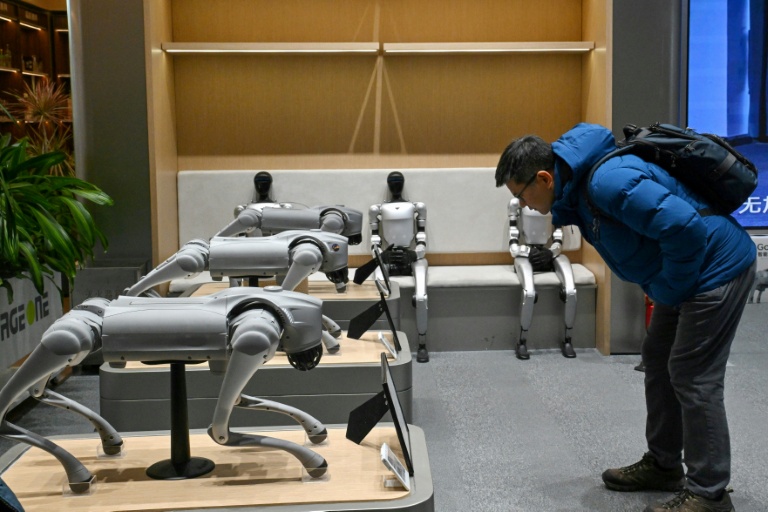
In a stark gallery corner, a battered robotic dog lies on its side, limbs frozen mid-kick, synthetic fur scuffed and torn. What captures attention isn’t just its lifelike design, but the thick metal chain wrapped tightly around its torso, tethering it to the floor. This is not a malfunctioning tech demo—it’s a deliberate, provocative artwork titled Systemic Restraint, and it has become one of the most discussed pieces in the ongoing conversation about artificial intelligence, ethics, and fear.
Created by multidisciplinary artist [Artist’s Name], the installation features a commercially available quadruped robot—similar to Boston Dynamics’ Spot—in a state of visible distress and restraint. The robot occasionally whirrs and jerks against its bonds, a programmed simulation of struggle, while a looped audio track mixes mechanical sounds with distorted whimpers. Viewers report feeling an unsettling mix of pity, discomfort, and alarm.
More Than Shock Value: Decoding the Symbolism
According to the artist, the chained robot dog is a multilayered metaphor. On one level, it represents our growing anxiety about autonomous systems—the fear that the machines we build might one day turn against us, requiring us to physically restrain or dominate them. But look closer, and the narrative deepens.
“We’re not just afraid of robots,” the artist explained in a statement. “We’re afraid of the chains we’ve already placed on ourselves—the algorithms that dictate our lives, the black-box AI making unfathomable decisions, the feeling that we are both the master and the slave to our own technology.”
The “thrashed” appearance of the unit is intentional. This isn’t a pristine, futuristic vision; it’s a used, abused, and degraded tool. It speaks to the rapid obsolescence of technology, the physical cost of innovation, and perhaps, the inevitable backlash against entities we cannot fully understand or control.
Public Reaction: Empathy for the Machine?
The visceral response has been fascinating. Many viewers anthropomorphize the tethered robot, describing feelings of sympathy as if it were a living creature. This reaction underscores a core tension in human-robot interaction: even as we fear AI’s potential, we project sentience and suffering onto machines designed to mimic life.
Ethicists and tech philosophers see the piece as a critical commentary on “ethics washing”—the practice of using performative displays of restraint (like chaining a robot) to reassure the public, while the underlying systems continue to operate without true transparency or accountability. The chain, in this reading, is a theatrical prop, a superficial solution to a deeply embedded problem.
A Broader Movement: Art in the Age of AI
Systemic Restraint is part of a growing wave of art interrogating our relationship with artificial intelligence. From artists using AI to generate unsettling portraits to performances highlighting data surveillance, the art world is becoming a crucial forum for public reckoning.
These works ask uncomfortable questions: Are we building a future of liberation or subjugation? Can we ever truly control intelligences that may surpass our own? And in our quest for progress, what part of our humanity are we risking—or already losing?
The Unshakable Image
The image of the chained robot dog persists because it crystallizes a diffuse cultural anxiety into a single, powerful frame. It reminds us that our fears about AI are not just about rogue data centers or unseen algorithms; they are also about the tangible, embodied presence of machines in our world and the power dynamics they represent.
The artwork doesn’t offer solutions. Instead, it holds up a mirror, forcing us to confront our own paradoxical impulses: to create, to control, and ultimately, to fear what we have created. In chaining the robot dog, the artist suggests, we may be rehearsing our own captivity. The piece remains on display, a silent, struggling testament to the chains we see, and those we don’t.
About The Author
