
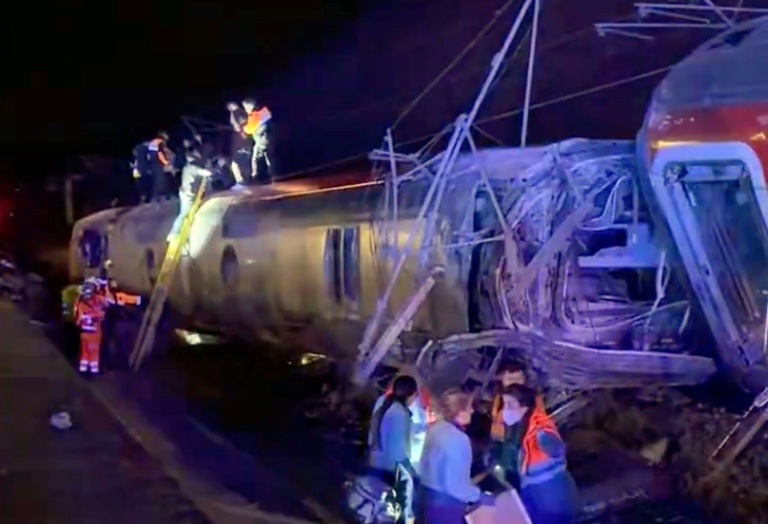
Catalonia, Spain – A day of ordinary travel turned to tragedy on Wednesday when two commuter trains collided head-on near the town of Montcada i Reixac, just north of Barcelona. The devastating crash has claimed at least 21 lives and left dozens more injured, many critically, plunging the region into mourning and raising urgent questions about rail safety.
The collision occurred around 7:50 AM local time on a section of track operated by Spain’s national rail company, Renfe. One train, operating on a local line from Barcelona to the suburbs, was struck by an oncoming train traveling from the opposite direction. The force of the impact crumpled the lead carriages of both trains, trapping passengers in a tangle of twisted metal.
Scene of Chaos and Heroism
Emergency services described a scene of “absolute chaos” in the immediate aftermath. Over 200 firefighters, medical personnel, and police raced to the site, working for hours under cranes and cutting equipment to free those trapped. The injured, numbering at least 45, were rushed to multiple hospitals in Barcelona. Medical officials confirmed that at least six of the wounded are in critical condition.
Survivors, shaken and covered in dust, recounted the sudden, violent jolt and the screams that followed. “There was a tremendous noise, and everything went dark,” one passenger told local media from a triage tent. “People were crying, and there was blood. It was a nightmare.”
Local residents were among the first responders, rushing to offer water and comfort before professional help could arrive. Their actions, along with the rapid deployment of emergency crews, were credited with saving lives.
A Nation Asks Why
As the rescue operation transitioned to recovery, the focus shifted to the investigation. Spain’s railway network, particularly its high-speed AVE services, is widely regarded as one of the safest and most advanced in Europe. A fatal accident of this magnitude is exceptionally rare.
The government has announced a formal judicial investigation. Early speculation from rail experts centers on potential human error or a catastrophic signaling failure that might have allowed both trains to be on the same track. Data from the trains’ “black box” recorders will be crucial in determining the sequence of events.
“We are facing a very sad day,” said Spanish Prime Minister Pedro Sánchez, who canceled his schedule to travel to the site. “My solidarity and affection go out to the families of the deceased and the injured. We are deploying all necessary resources and will conduct a rigorous investigation to determine the causes of this terrible accident.”
A Community Grieves
Flags flew at half-mast across Catalonia as the region began to process the scale of the loss. The victims were largely commuters—people on their way to work, school, or daily appointments—a fact that has made the tragedy feel intensely personal for the surrounding communities.
A minute of silence was observed in the Catalan parliament, and grief counseling centers have been established near the crash site and at major hospitals.
The crash is Spain’s deadliest rail disaster since the 2013 Santiago de Compostela derailment, which killed 80 people. That accident, caused by excessive speed on a curve, led to renewed safety protocols and driver monitoring systems. This new tragedy will inevitably lead to fresh scrutiny of whether those measures are sufficient on all lines.
For now, a nation’s thoughts are with the victims and their families. As the investigation continues, the questions of “how” and “why” loom large, but they are overshadowed by a profound sense of loss for the lives abruptly ended on a routine Wednesday morning journey.
About The Author
