
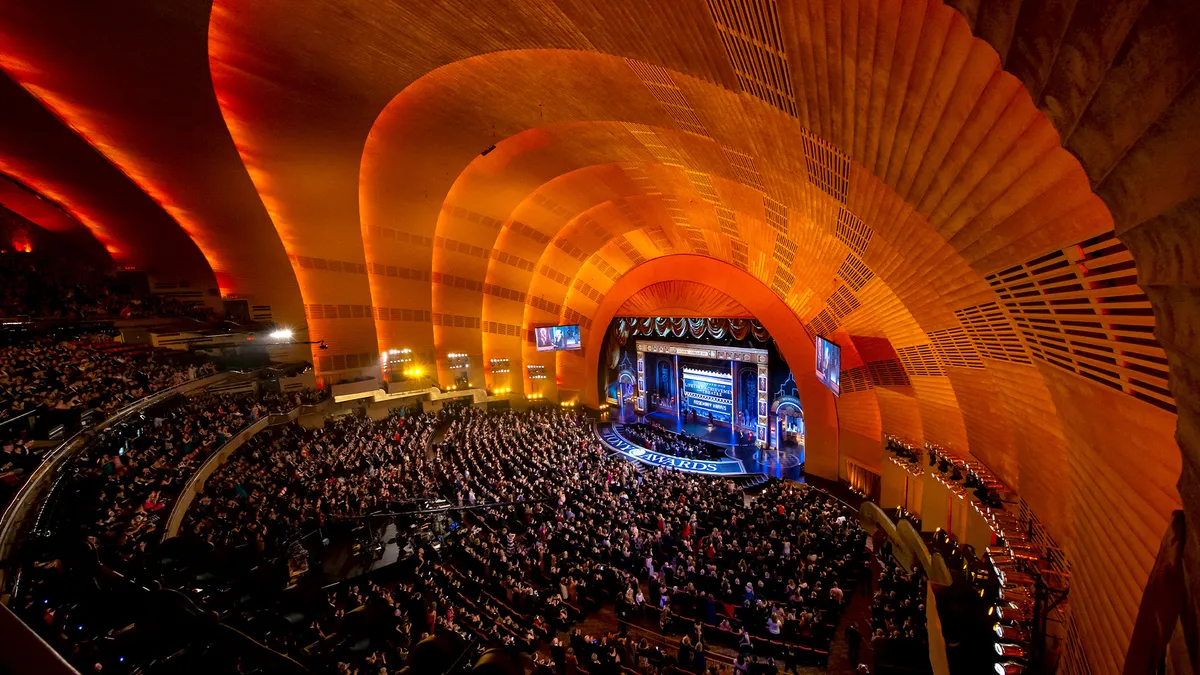
In the heart of Manhattan, amidst the dazzling electric symphony of Rockefeller Center, stands a monument not of stone, but of spectacle. Its marquee, a beacon of neon and promise, has illuminated the aspirations of performers and the wonder of audiences for over nine decades. This is Radio City Music Hall, the “Showplace of the Nation,” a cathedral of entertainment whose story is woven into the very fabric of American cultural history.
Conceived during the audacious optimism of the late 1920s, Radio City was the vision of John D. Rockefeller Jr. and the theatrical impresario S.L. “Roxy” Rothafel. It was to be the crown jewel of the new Rockefeller Center complex, a palace for the people in the midst of the Great Depression. Architects Edward Durell Stone and Donald Deskey embarked on a mission to create not just a theater, but an experience. They rejected the traditional, gilded European opera house model, embracing instead the sleek, optimistic spirit of Art Deco—a style born for the modern age.
The result was, and remains, breathtaking. To step into the Grand Foyer is to be enveloped in a symphony of elegance: vast mirrors, golden accents, and a sweeping staircase fit for a Hollywood premiere. But the true revelation lies beyond the auditorium doors. The sheer, awe-inspiring scale of the space—a single, vast room seating nearly 6,000—is masterfully balanced by its exquisite detail. The stage, a 60-foot-wide proscenium arch, is framed by a majestic, abstract golden curtain, designed to resemble a radiant sunset. Above, the ceiling stretches like a celestial vault, with concentric circles of lights mimicking the heavens.
Yet, Radio City was always more than a beautiful shell; it was an engineering marvel. Its legendary Great Stage was conceived as a “stage of the future.” A system of hydraulic elevators allows sections to rise, tilt, and disappear, enabling seamless, cinematic scene changes. This ingenuity birthed the theater’s most iconic residents: the Rockettes. Founded by Russell Markert, this precision dance company, with their impossible synchronization and iconic eye-high kicks, became the living, breathing soul of Radio City. Their Christmas Spectacular, a tradition since 1933 featuring the unforgettable “Parade of the Wooden Soldiers” and the living nativity, has become a holiday pilgrimage for generations.
The Music Hall’s history mirrors America’s own cultural journey. It opened in 1932 as a combination movie palace and vaudeville stage, featuring the latest films alongside lavish stage shows. It hosted legendary premieres, from King Kong to The Godfather, and its stage has been trod by every imaginable star: Frank Sinatra, Ella Fitzgerald, The Beatles, Beyoncé, and countless others. It has been the home to the Grammy Awards, the Tony Awards, and the MTV Video Music Awards, cementing its status as the ultimate venue for celebration.
But its path wasn’t always smooth. By the 1970s, changing tastes and economic pressures threatened the Hall with demolition. It was then that a miracle occurred: a passionate public outcry. Led by celebrities and ordinary citizens alike, a preservation movement succeeded in getting Radio City designated a New York City Landmark in 1978. A massive restoration returned every brushed-aluminum fixture and Rayon velvet wall covering to its original glory, proving that the public’s love for this palace was its most powerful foundation.
Today, Radio City Music Hall endures as more than a theater; it is a living archive of collective memory. For the tourist, it is a must-see spectacle. For the New Yorker, it is a proud and familiar anchor in a shifting city. For the artist, it remains a career-defining pinnacle. It is a place where a child sees their first Christmas show, wide-eyed at the towering living tree, and where a music legend feels the roar of a packed house.
In an age of fragmented media and digital isolation, Radio City stands as a defiant testament to the unique, irreplaceable magic of shared experience. It is a monument to the audacity of dreams—dreams built during a depression, saved by public love, and sustained by the simple, enduring power of a great stage, a brilliant light, and the thunderous applause of 6,000 people united in wonder. The show, as it has for nearly a century, most gloriously goes on.
About The Author
